
B
THE STORY OF MARGRET
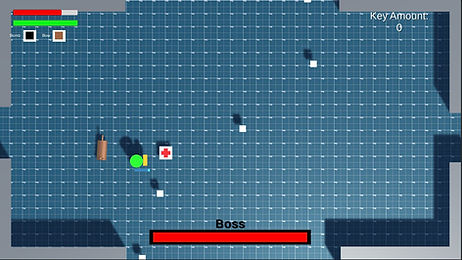
The Story of Margret is a prototype build during my final August at Full Sail. Made with the same team members as Downfall, this project took about a month.
We created a functional prototype of The Legend of Zelda making sure to replicate the main mechanics like combat and exploration. We then added new features like a stamina bar, weapon swapping, dashing, and a companion to create a functional prototype with an enjoyable feel.

Level 7 -
Now with the lock and key, the level balances a healthy understanding of five different mechanics while introducing the player to something new and from playtests the lock and key only improve the pacing and overall enjoyment players showed during play.
When the player collides with the three colored key the blue gate will disappear, and the way is opened. This level took some fine tuning to make sure the player didn’t run out of fuel and that the player would collect the key without any instruction from me.
Level 5 -
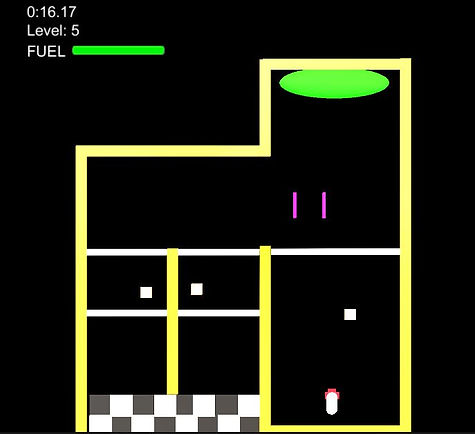
This screenshot is level 5 as it is in the current prototype, as you can see above the layout hasn’t changed too drastically. The main change is the final section that allows the player to choose either a right or left tunnel to the finish.
This level makes use of a mover, several breakable walls, and the new swapper asking the player to reinforce their knowledge of previously introduced mechanics while being introduced to a new one.

The Flipway itself is modeled after the probability tree of a coin flip. Once a level is clear and the dice folk saved, the player is must hit the Flip button to flip the grand coin. Depending on whether the coin lands on its Sun or Moon face will determine the state of the next level they experience. Shown here is the map shown in game that shows the player where they are in the Flipway.
Flipway: Chance of Freedom

Flipway: Chance of Freedom is an instructional edutainment game made for the company Legends of Learning. Centered around the concepts of compounding probability, the game takes place in the Flipway where the player casts mathematical spells to save the Dice Folk from the dreaded Uncertablob. To properly cast spells, the player will need to answer questions regarding compounding probability that get more difficult as they traverse the flipway. The game is available to play on the Legends of Learning website with a free teacher account and to students in schools that use Legends of Learning in the classroom.
SPACE MAZE
Space Maze is a prototype derived from games like Space Race where the goal boils down to get to crossing a finish line. The prototype was made in roughly a three-month period as a personal project but grew in scope along with personal interest. I took a game about dodging asteroids and developed it into a puzzle game that I have every intention of expanding further.
The game contains 10 levels that increase in difficulty and complexity as the player progresses challenging them to learn and master different mechanics. Players will have to dodge asteroids, manage fuel, collect keys, and fire lasers to cross that checkered line.

Above is the title screen and below are two examples level layouts
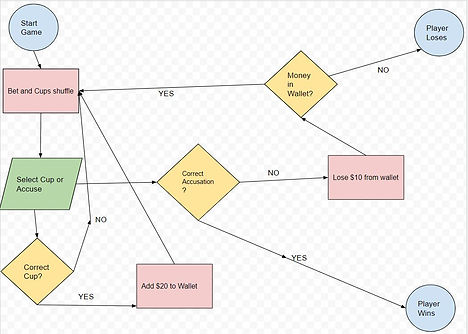
Grift_Code was made in a month during a class at Full Sail. I was wanting to make a puzzle game and was also studying games of chance at the time. One of the games that really stuck out was the shell game and a memory of losing twenty dollars to a guy in New Orleans who asked me to "find the pretty lady". Half betting game and half puzzle game, I'm contantly writing down new ideas of how to iterate this game more.
THIEVERY
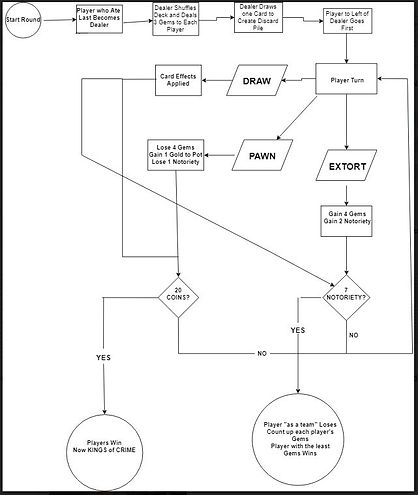
Thievery is a cooperative card game for three to five players. Players will take turns drawing cards, gaining gems, selling gems for coins, and avoiding the authorities to make it big as a gang of thieves.
Players will need to amass 20 coins to win before gaining seven notoriety counters. If seven counters are in play before the players gain 20 coins, the team loses.
However, the player with the most gems will win as they are able to pay off the authorities, creating competition between players in the event they lose.
Level 7 –
Level seven is very different now compared to this layout done in Google Drawing during the design phase. The layout was not very flushed out and would later change to accommodate the new Lock and Key mechanic added near the end of development. This level was initially intended as an advanced skill check for the swapper, laser, and mover mechanics but never found footing until the introduction of the lock and key. key.

This level was also made before the introduction of the fuel mechanic which added a layer of tension. As you can see, there are frustrated notes and cyan lines that show the desired path vs the yellow line which shows the path all play testers took until the addition of the lock and
The game is all about setting up equations properly and calculating numbers from given word problems. Shown here is a layout of the equation template in game. Above is the question with two images on either side to assist the player in solving the problem. The player needs to click a number, then click the space in the equation where they want that number, once they are satisfied with their answer, they will hit the submit button and will be told if their answer is correct. If the player is unable to answer the question on the first attempt, a hint will be available to them on the second try, and the ability to skip the problem on a third attempt.


Level 5 –
This is an example of a level that did not change too much from start to finish. In layout above you can see this is the first level to introduce the ‘Swapper’, a large green area that changes the direction the player moves. The player moves ‘up’, past the asteroid, avoiding the ‘Mover’, then collides with the swapper, they now can only move and shoot ‘down’. This allows the player to progress to the finish line and on to level 6 where the swapper is used more robustly.
The yellow path shown is the path the player takes to complete the level, and the red lines are the most common deaths in this level. This layout was also done before the implementation of the fuel mechanic and the player did not have the ability to destroy asteroids.
Development lasted about four months with each team member more or less doing a bit of everything. Each team member designed their own level around the main mechanics of the game. I was in charge of level two, entitled Gravity Flow, which introduces the second main mechanic of the game, the gravity wall.
With four walls that change the fall direction of the player, I thought it best to introduce each wall with a set of obstacles without increasing the difficulty of those obstacles. During testing we found that the shift in perspective was enough added difficulty.

GRIFT_CODE

Grift_Code is a small puzzle game about a lying computer. The player will be betting money in a simple shell game to try and find a golden ball. Occasionally the computer will remove the ball from play. To win, the player will need to accuse the computer when the ball is out of play. The player will lose if they run out of money.
Compromise

Compromise was a game designed during a junior level class in about a month. The greater class project was entitled Temporo Ludum, and had us test and re-evaluate our design to create something fun and engaging.
Our rules needed to fit on one page, and no game between two players lasts more than 30 minutes. Compromise has players moving red and blue tokens across a board to both capture territory and the their opponents pieces.
Players move their tokens by rolling one six sided die, then moving one piece that number of square in any direction they choose as long as the number of squares moved matches the rolled number.
Designing this game was a lot of fun as was testing. Being able to only create so many rules with a certain play time was an enjoyable challenge. I'm a big fan of those kinds of constraints as I feel it breeds some truly amazing games.
Compromise is an enjoyable and somewhat strategic game for two people that caused me to think outside of the box while designing. The most dramatic example of this was the size of the game board. It changed drastically from week to week as I played with different grid arrangements. The one you see above was the best by far especially with the addition of the Compromise Line in the middle.

DOWNFALL
Downfall is a platformer with an emphasis on navigation puzzles and combat. Designed for Capstone at Full Sail, Downfall took about four months to complete. Designed by seven people, each team member of Capstone's Finest did a little bit of everything. We focused on fun and engaging gameplay above anything else and are really proud of what we made.
Play Here: https://gddes.itch.io/downfall